An equal and opposite reaction: How to wrangle emotions and subjectivity in a naming program


Mel Brooks was asked, "What's the hardest part of making a film?"
He answered, "Cutting all those little holes in the sides."
   
Naming's like film. The hardest part of making a brand name is the cutting of little holes in the names. In other words, idiosyncratic and subjective reactions — poking holes — are what really make the naming process difficult.

Because emotions and subjectivity are an inevitable part of the process, it's helpful to know how to work well with them.

In the second half of my interview with Irene Gil of Grasp, I discuss key principles and practices for naming practitioners. Her verbatim Spanish translation can be found here.  


Q: It is incredible the quantity of emotions that are managed during the process and how political the decision can be. How can be anxiety managed? How to avoid that names with a good brand potential are rejected at a first sight?
Anthony Shore:
No matter how hard one tries to make it an objective exercise, naming is subjective and emotional. Each client in a meeting has their own associations with a word; it is often assumed — incorrectly — that others will have the same idiosyncratic associations.

Here's how I wrangle the emotions and subjectivity that attend brand naming programs:

Each client needs to feel that their opinions and ideas have been heard throughout a naming program. Active listening, that is re-stating what the client said, shows you've listened. So does writing it down. It's vital that your naming creative brief reflects everything important you've heard; a name presentation should repeat the most important points of your creative brief, and name rationale should feature those same points.

If a client asks you to explore a word or an idea or a name style in your creative work, do it, even if you disagree. You are obliged to advise the client of your concerns, but it's really in your best interest as a naming practitioner to fulfill the client's request. Failure to do so might make the client much less receptive to your names. That same client could "poison the well," and make offhand, pejorative comments that derail other names.

It's often true that good candidate names — especially highly differentiated ones — may be rejected by clients, leading to the brander's paradox: Differentiated ideas are essential to effective branding, yet differentiated ideas are initially rejected simply because they are unfamiliar.
I delve into this topic in Instinct as Enemy where I recommend these techniques to rally support for new and unfamiliar names:

Repetition
Each candidate name should be said several times so it begins to feel familiar.

Analogy
When a presenting a differentiated name, give your client examples of other successful product or company names that are comparable in style, metaphor or construction. When a client sees that someone else has tried the same naming approach and succeeded, they'll warm up.  

Context
Presenting candidate names in a real-world context, like a business card, web page or building sign, helps make the candidate name seem less speculative and more like a real, de facto brand.
Q: What do you think should be the role of research in a naming process? Do you recommend the naming test?
Name research must be done mindfully and for the right reasons. In Decisions, Decisions: How to Research Brand Names, I write that research should not be used to "pick a winner." Instead, research should illuminate the names' relative ability to support the brand positioning and attributes. Research can reveal "red-flag" associations and provide creative ideas for messaging and launch of a name. Research can neutralize some of the subjective associations and political dynamics around names.

Name research should not ask customers what names they "like," whether the names "fit with the category" or if they are "memorable." I advise against using focus groups for name evaluation and instead suggest one-on-ones. Focus groups can be useful before naming begins to learn what features or benefits are important to them and what their "pain points" are. This understanding can guide the brand positioning and inform the naming strategy.
Q: Having conducted the Accenture huge naming process, what do you think of employee's competition?
As I mentioned, I believe that great names can come from anywhere. Naivete can inspire wonderful names or terrible ones. Accenture notswithstanding, whose name was developed by an Accenture employee, an employee competition will not very likely bring forth a good, trademarkable name. In my experience, employee contests tend to garner names that are descriptive or obvious. 
Perhaps most problematic, an employee naming contest signals that it's not a difficult, strategic or terribly important matter. Companies do not throw contests asking which competitor should be acquired, whether a line of business should be divested, or how their flagship product should be positioned.

Q: When you work in global names, how do you assure there are no negative connotations in other languages?
You need to ask the right people the right questions and evaluate their answers critically. When people are exposed to candidate brand names in a linguistic check, there are personal associations that would not arise after the name is adopted and launched. The challenge is to determine the nature of foreign speakers' associations. You have to make a judgment: Is a negative response to a name just one person's idiosyncratic reaction or will it be widespread? And if a negative reaction is likely to be widespread, does that really matter?

For example, if Nintendo tested the name Wii for negative connotations in the U.S., it would have bombed mightily: It's homonymous with a childish word for penis and peeing. Yet, the name and product have succeeded because (1) the product's appeal eclipsed its giggle-inducing name and (2) the name was brought to life with animation (the two "i"s bow) and nomenclature (Wiimote). Today, you can ask someone to come over and play with your Wii without getting slapped.

As the success of names like Wii, Virgin, Motley Fool and Banana Republic demonstrate, negative connotations aren't necessarily bad.

These are some of the questions I ask when conducting native speaker checks: 
How will this word be pronounced by a native speaker of your language? 
Is the word similar in sound or appearance to other words in your language? If so, what are those words, how are they pronounced, and what do they mean? 
Are there any inappropriate associations that a native speaker of your language might have with this word? If so, what exactly are those associations and why would they be associated?
Q: Do you think brand names have to be liked by the majority of the target audience or is it good to provoke a certain controversy at least in its launching?
With time and exposure, people will grow to like a name, no matter how they felt about it at launch. The day Accenture launched, a few people quipped the name sounded like "dentures." On day 2, nobody did because the name took on an identity all its own. That happens with all names.

A name is liked as much as the product or company it refers to.  If the product is great, people will think better of its name than if it's lousy. The name Andersen Consulting was revered when a judge compelled the company to rename. Months later, when Accenture's former parent company, Andersen Worldwide, melted down because of Enron, the Andersen name was rendered toxic. Accenture, even though it was a new name, became even stronger and more favorable in the aftermath.

Controversial names have the benefit of being different and memorable; they trigger strong emotions that forge a bond. These are desirable traits in a name. But a controversial name should be borne from the brand positioning. Irrelevant controversy can undermine or overshadow brand messaging. For example, the name FCUK is controversial but well-suited for rebellious teens. But the recently launched Kraft iSnack 2.0 didn't work, even as a "next generation Vegemite." The name was retired after just a few weeks of public ridicule. Cheesybite, a suitable, not-stupid name, took its place.
Q: In my experience, to find a good name is just 50% of the task. The other 50% (or even more) is to convince the company that it is the adequate decision. Do you agree?
For most projects, generating a list of strategic and fresh names is not that hard, especially when you've been doing it for 30 years. Convincing a roomful of clients to adopt the best one is another matter. It's when the rubber hits the road, when clients balk at or mock your names, where experience in naming makes a huge difference. An experienced namer will be able to persuade a client to adopt a powerful, meaning-laden, real-word name or a controversial one. An inexperienced namer might be able to sell-in a name, but it will probably be an "empty vessel" coined name that doesn't arrive with much meaning. Names that don't say anything also don't have much to criticize...or to love.    

Thank you, Irene, for translating and sharing my thoughts with your Spanish readers.

What's in a namer?

It's ironic. I spend my days helping clients exercise discipline and economy in their brand expressions, but can't do that myself once I get talking about naming. Really, it's hard to shut me up. 

Case in point: What should have been a quick little interview for Grasp, a Spanish naming blog, I turned into diatribe so long that it couldn't fit into a single post.

Iberian blogger and namer Irene Gil faithfully translated my responses in their entirety. She must know what it feels like when fingers beg for mercy.  

My English answers to Irene's first two questions are below. Her painstaking Spanish translation can be read here. 

Q: Anthony, from your long experience, what is the best profile for a good namer? It's an MBA specialised in brand strategy? It's a linguistic with a sound knowledge of different languages? It's a very cultivated person with a broad vocabulary?...
Eleven years ago, a veteran namer told me the best namers are linguists with an MBA. That captures 2 dimensions of a good namer, but I believe that characterization is incomplete.   

Good namers are specialists who, paradoxically, are often the best generalists.

A namer must be a good:

Account manager
Listening to clients, building their trust, reading non-verbal cues from a room of executives, responding positively and not defensively to client concerns and building consensus are all vital naming skills, just as they are good skills in account managers.

Strategist/Account planner
A namer must think strategically to ensure their names support client's business objectives. Strategic thinking and rationale build the namer's credibility and make them more persuasive. Good namers, like good planners, always consider the customer perspective.

Creative
Creating good names requires looking at a client's business from many perspectives. Namers must be creatively prolific and fearless. And as fellow "grizzled veteran" namer Mark Gunnion said in this interview,
"You have to be thick-skinned -- 99.9% of what you create is rejected, usually without a second glance or explanation."
Storyteller
Engendering client trust and helping a client see how a word could become their brand requires great storytelling. Your name story and rationale must be persuasive and pass the "sniff test". An effective name presentation brings together the right blend of emotion and logic.

"Sprachgefuhl"
It's a German word that means "a feeling for speech". Good namers understand the nuances of words and meanings. Good namers are articulate. And only a person madly in love with words could become a namer. But love and knowledge of words is not enough. As I wrote in Knowledge vs. Naivete, linguistic expertise is helpful for naming but so is the ability to "turn off" that knowledge and imagine how names would be perceived by a typical customer.

Marketing communicator
Good namers must consider how their names might come to life across all communications: Visual identity, advertising, messaging, PR, merchandising, etc. Although namers typically don't design logos or advertising campaigns, their ability to communicate their names' potential helps identify and persuade the client of the best ones.
Q: If everybody is able to create a brand, why subcontract this task to a namer? What is the added value?
I honestly believe that great names can come from anyone; founder-created names like Apple, Virgin, Amazon and Google prove this. But involving an expert namer can help in ways tangible and intangible:

Make clients money
A great name has the right sound and meaning, making it more likely to be shared by others through word-of-mouth. A great name inspires merchandising that becomes a new revenue source. Great names that can accomplish these bottom-line benefits (and clear trademark hurdles) are more likely to be created by an expert namer than a client who is not an experienced namer.        

Save clients money
A great name is intrinsically memorable so it needs less marketing to be remembered. By giving good advice, an expert namer can help clients' avoid trademark infringement and other costly problems. For example, in 1997 Reebok launched -- and then recalled -- a women's running shoe called Incubus. A good namer with a good liberal arts background would have advised Reebok against this name: an Incubus is a demon who attacks women in their sleep.

Build consensus
A namer is a neutral, disinterested party who can build client consensus and trust because they are insulated from their client's internal politics.      

Accelerate timing
A good namer helps clients avoid problems that can delay naming programs. Pro namers maintain forward momentum by managing expectations, building client consensus, developing a breadth and depth of unique names, and weeding out obviously problematic names in trademark and international linguistic assessment.

Build confidence
A good range of naming creative, logical rationale, name launch strategies and marketing approaches builds client confidence in their name choice. 

Ease client workloads
Clients already have a job to do, and it's probably not naming. An outside namer removes this burden from their client and shields them from the emotional perils of moderating a naming discussion. It's better if an outside expert rejects a [terrible] client-created name than a colleague.
After Irene's fingers recover, she'll translate and post more of my interview.

Creative names the easy way

What does a stylish mobile phone have in common with a nightclub?

When it comes to naming, everything.

Nightclubs and phones can share the same abstract characteristics, so they can share the same name. A nightclub can be stylish, as can a phone. They can both be friendly or alluring or opulent or minimalistic. A trademarked name that suggests any of these qualities in a nightclub will do the same for a phone.

This works because trademarks act like adjectives (e.g. Bounty®) that modify nouns (e.g. paper towels). An adjective retains its essential meaning even when modifying different nouns: A clear window, a clear path, a clear thought. (Technically speaking, trademarks are really not adjectives but "attributive modifiers" as Geoff Pullum of Language Log pointed out.)

Homonymous brands put into practice this principle of persistent meaning. The names Microsoft Excel and Hyundai Excel imply performance. Edge tennis rackets and Edge shaving gel are both edgy. Anything called Venus is for women: razors, phones, emollient, etc.

This phenomenon forms the basis for my favorite creative naming technique:

The cloaked brief

A cloaked brief is ostensibly for a product different than the real one, but shares the same desired brand attributes. The idea is to name something else.

Instead of briefing my creative team on our client's hot, new phone, I'll brief them on a hot, new nightclub.

There are, in fact, cell phones and nightclubs named the same. Geeksugar noticed and made a quiz of it; many quizzes, actually, each based on the similarity between cell phone names and the names of energy drinks, 80's TV shows, ladies' razors, Hitchcock films, Britney songs, perfumes and chewing gum.

I've found cloaked briefings effective for naming both companies and products. Done well, they can inspire and energize "creatives" more than straightforward approaches. A detailed and colorful cloaked briefing enables a namer to suspend disbelief. It immerses them in the lie.

Cloaked briefings will:
  • Inspire strategically-targeted creativity in you and your team
  • Accelerate generation of differentiated and relevant names en masse
  • Increase the likelihood of securing trademark registration because the names are borne of divergent, out-of-category thinking
How to create a cloaked brief:
  1. Establish the key strategic, distinguishing attributes of the thing you are naming (e.g. a mobile phone that's stylish and friendly)
  2. Brainstorm categories of other things that embody those attributes (e.g. nightclubs, spas, concierge services)
  3. Pick a category that's unexpected and interesting (e.g. nightclubs)
  4. Outline a naming brief based on an imaginary yet credible product from that category. The more attributes the imaginary product has in common with the real one, the better. (e.g. name a nightclub in LA that lavishes its guests with attentive service)
The desired attributes should be intrinsic to the cloaked category. Nightclubs are invariably stylish (or strive to be), so that's a good cloaked category for naming a stylish phone. If the phone is rugged rather than stylish, SUVs would be a fruitful creative (mis)direction.

Here's an example from my own experience: On an embedded-technology project, the client said their product will make computers so much more powerful, vibrant and useful that people would be wowed by the experience. Therefore, the new technology name should be as remarkable as the devices that would be powered by it.

How do you inspire remarkable names? Name something remarkable.

A member of my team came up with the brilliant cloaked creative direction to name a remarkable new circus. It would have exactly six of the "World's Greatest" people in it: The world's greatest acrobat, world's greatest magician, world's greatest contortionist, etc. (the number six referred to the six capabilities of our client's product). Every performance would leave spectators agog. Cirque du Soleil would seem lifeless in comparison.

Naming a circus troupe instead of technology? That's like comparing apples and orangutans.

But it worked.

The creative results of the exercise were astonishing; dozens and dozens of names I had never seen on any list made their debut. Having worked on over a thousand naming assignments, that's remarkable indeed.

The names were not just creative, they were also relevant and strategic because they elicited the visceral awe and wonder that defined the brand.

The circus direction was effective because circuses are intrinsically spectacular.

Cloaking is helpful for naming research, too. Asking respondents to rank candidate names against attributes in a cloaked category (instead of the actual product category) can eliminate category bias and increase participants' comfort with differentiated creative. So if you're testing names for a fast microprocessor, tell respondents they are names for race cars or jet engines.

I discuss this and other name research techniques in Decisions, decisions: How to research brand names.

For your next creative naming project, I encourage you to give cloaked briefings and cloaked research a shot.

I'd love to hear back if you've tried this approach and what kind of results you've seen.

Describe different

"What am I?"

Every invention begs this essential question of identity.

The answer is found in the product's descriptor. A descriptor defines a thing, categorizing it, framing it, positioning it and signaling its intended future.

A product that doesn't claim to break new ground adopts its category's standard convention. For example, a new, run-of-the-mill digital camera would be marketed as a "digital camera".

A revolutionary product, on the other hand, deserves an innovative product descriptor. And, sometimes, a me-too product benefits from one, too.

The trouble is, innovation is easier done than said.

I wrote in this article about the "brander's paradox": Human instincts make us wary of unfamiliar and different things, yet differentiation is essential to a product's success.

By definition, an innovation is unfamiliar. How can its product descriptor differentiate without triggering people's fear of the unknown?

The New York Times gives us an idea in this recent article about product descriptors,
"When people encounter something they don’t recognize, they make sense of it by associating it with something familiar."
The most effective new descriptors combine familiar terms in unfamiliar ways. They make product function or form clearly understood, even upon first exposure. Novel descriptors insufficiently informative should at the very least pique interest.

Descriptors that differ

The following products illustrate different approaches:

Starbucks VIA ready brew


It's a me-too product but you can't tell from its descriptor. This is really instant coffee, a product designator unbecoming Starbucks. "Ready brew" emphasizes the chief benefit of saving time by using current, casual vernacular.

Dreyer's Slow Churned ice cream


Food scientists have a name for everything, but that name isn't always appetizing. The dessert wizards at Dreyer's, for example, had perfected a new way to blend low-fat ice cream so it acquires the texture and richness of full-fat ice cream. In precise but dry science lingo, they called the process "low-temperature extrusion". Doesn't exactly make the mouth water, does it?.

Dreyer's isn't dumb. They knew "extrusion" had no place on a quart of mint chip. They needed a term that had immediate appetite appeal. The words of their final, market-facing descriptor, "Slow Churned", taps into the semiotics of yesteryear, when food was simpler, unprocessed, and naturally indulgent. "Churned" evokes hand-mixed barrels of butter, hinting at the product's creamy richness. "Slow" connotes food that's unprocessed and handcrafted.

On the heels of Slow Churned ice cream's astounding success, Breyer's flattered Dreyer's with their imitative descriptor, Double Churned ice cream.

Disclaimer: I led the naming of Dreyer's Slow Churned ice cream as Global Director of Naming and Writing at Landor Associates.

Bing decision engine

Can't fault Microsoft for trying. Bing is a search engine, pure and simple. Although "decision engine" will never become part of the vernacular, it does suggest how Bing is different: Giving relevant information to help make a informed decision, instead of overwhelming with googlebytes of information.

Noah's Stuffed Saladwich


Coined words are hard to get right. This inventive, efficient descriptor gets mixed results. At a glance, "saladwich" looks like real word because it begins and ends with the same letters as "sandwich" (a phenomenon cheekily called, "typoglycemia"). But "Saladwich" sounds clunky because "-wich" is not a productive suffix and doesn't normally combine with other words (unlike the "-tini" of "martini" that gives us "chocotini" and "apple-tini"). "Saladwich" will sound less contrived as it becomes more familiar.

Blackberry wireless email solution


Technology products that blend hardware, software and services are tough to describe. More often than not, catch-all words like "solution" or "system" are employed. Though vague, these words avoid long descriptors that specify all key product dimensions. "Wireless email solution" is a lot shorter than "phone, PDA, email, internet, software and services." To its credit (and my alma mater's, Lexicon), the differentiation in Blackberry is borne primarily by the Blackberry name itself, not its ho-hum descriptor.

Segway personal transporter


This NYT article discusses the difficulty categorizing the Segway, a product that's really unlike anything else. Although the article touches on the brand name, it doesn't mention Segway's official descriptor. "Personal transporter" suggests who the product is for and what it does at a basic level, but it doesn't capture how revolutionary the product is, what it looks like or even whether it's motorized.

But a descriptor can't do everything. Like most products visibly inventive, a photo of the Segway speaks volumes. And messaging, mostly communicated through PR, does the heavy lifting of describing Segway technology and its applications.

Describing technology convergence

Each of the products above fit, more or less, into one functional category. But in electronic devices, disparate functions inevitably converge. Over time, we've seen phones integrate video cameras, music players evolve into movie players, and televisions that browse the Web.

Technology convergence presents a naming quandary: How do you categorize a product that merges others?


There are five approaches a marketer can take when describing one device that does the work of many:

  • List all of the converged technologies (e.g. "all-in-one printer, fax, scanner")
    Long but accurate, clear and communicative. Needs to change as new functions are added. Generic and not protectable.
  • Cite one function only (e.g. "mobile phone" [the built-in camera is not referenced in the descriptor])
    Short; relies on copy and imagery to tout other functions. Doesn't suggest "new". Generic, not protectable.
  • Use one of the technology descriptors as the focus but modify it (e.g. "smartphone")
    Short; borrows from the familiar to aid understanding. These descriptors can take a long time to be adopted by industry and customers. It helps if the modifier is already understood from other categories and retains that meaning. May or may not be protectable.

  • Come up with something totally new (e.g. "media center")
    In naming, unfamiliarity is friction. Descriptors like these resist widespread adoption. They typically require a lot of time and money to gain traction. May or may not be protectable.

  • Use no descriptor at all (e.g. "iPod")
    This is a risky approach and is only viable when the device marketer has
    (1) control over all communications, distribution and sales
    and
    (2) a lot of money.
Apple has conspicuously avoided using a product descriptor per se for iPod. It turns out, they didn't need one. No distributors or resellers could tinker with Apple's disciplined and exacting messaging. At launch, the ad headline, "1000 songs in your pocket" made it clear the iPod was a portable music player.

Today, the iPod has grown in function and familiarity. So confident is Apple, they answer "What is iPod touch?" with "A great iPod. A great pocket computer. A great portable game player." When you can recursively describe your product and people get it, you've transcended product descriptors and become a category unto yourself.
 

The iPod answers "What am I?" with the most basic statement of identity, "I am me".
I guess if you're iPod, that's all you need to know.

###

Take the innovation descriptor challenge!

Innovations are easier done than said. See if you can come up with better product descriptors than these:
  • Segway personal transporter
  • Blackberry wireless email solution
  • The Internet global network
  • Onstar in-vehicle safety and security system
  • Wii console
Share your ideas in the comments section.

[This article was originally published in Duets Blog]

Branding Mavericks

“How far should our brand stretch?”

It's a question every brand manager must ask.

In our sluggish economy, businesses want to wring every dollar possible from their assets. One way to do that is by extending brands into new product lines.

For example, Starbucks extended their brand to liqueur and ice cream. The company makes money and consumers can enjoy products with authentic coffee taste. It is good.

But stretch a brand too far and it loses meaning -- and money.

The dangers to overextension are:
  1. the initial investment will not be recouped when the new product flops
  2. you'll tick off your most loyal customers who feel betrayed, thus giving competitors an opportunity to steal market share.
Coke pursued Pepsi youth with New Coke. We all know how well that went. And Virgin can mean a lot of things -- travel, music, telephony -- but apparently not cola. Bic tried pantyhose on for size. Didn't fit.

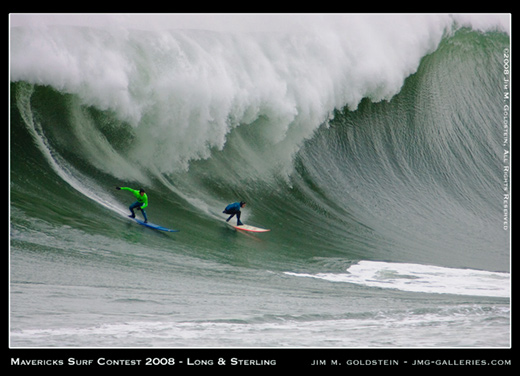
I live in San Francisco, 25 minutes north of a notorious surfing spot called Mavericks. Once every year or two, when the winter conditions are just right, the world's best big-wave riders are invited -- with only 24 hours notice -- to surf Mavericks' grotesquely giant waves.

The bigger they are, the harder they fall. A 50 foot wave falls hard.

It's a deadly contest. Literally.

Today, Mavericks has a small, dedicated following of surfers and others who are drawn to its danger and unpredictability. For them, Mavericks represents the ultimate confrontation of Man vs. Nature. Those who survive the mountainous waves have cheated death. And until proven otherwise, these gods-among-men are immortal.

At its core, the Mavericks brand means more than just a surf contest. That's why it has "permission" to extend to other categories -- up to a point.

Mavericks Surf Ventures recognizes the potential of their brand. To build visibility, Mavericks will sponsor a live reggae music tour. The intent is to build broader awareness before applying the brand to clothing and other sensible -- and lucrative -- product categories.

This week, the Half Moon Bay Review asked me if I thought Mavericks ought to be extended to live music tours. This is what I said:
“There’s a good long-term position (company executives) are tapping into for the recognition and awareness of Mavericks. ... They need to make sure the spirit of the Mavericks brand is reflected and held true within the context of that sponsorship,” Shore said.
So, yes, I do think it's a good idea to extend Mavericks into live music as long as the brand managers don't betray what the brand really means. A reggae tour is a natural fit. A Celine Dion tour is not.

Beyond music, Mavericks could move smoothly into clothing or sporting equipment. But some product categories, say...nursing homes or flatware, would make no sense.

Someday, Mavericks-branded products could compete directly against a surf brand like O'Neill, an adventure brand like North Face, and a human potential brand like the Olympics.

As long as the Mavericks brand managers don't get too maverick, they can look forward to a brand that will keep on giving.